What Is a Mushroom Spore Print? Everything Beginners Need to Know
What Is a Mushroom Spore Print? Everything Beginners Need to Know
A mushroom spore print is one of the simplest and most useful tools in mycology. By allowing a mature mushroom to naturally release its spores onto a clean surface, you can reveal the colour of the spores and collect material suitable for microscopic examination.
Learning about a mushroom spore print helps beginners understand fungal reproduction while providing valuable information used in identification.
What Is a Mushroom Spore Print?
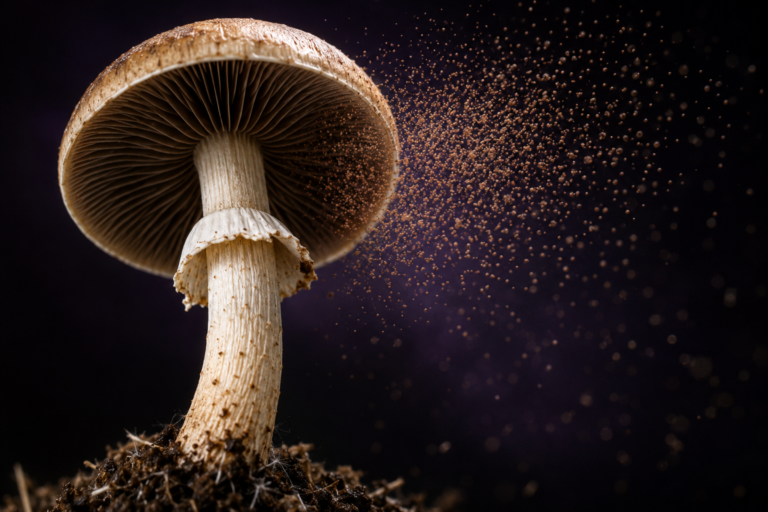
A mushroom spore print is the visible pattern created when millions of microscopic spores fall from the gills of a mature mushroom onto foil or paper.
Although each individual spore is too small to see with the naked eye, together they form a detailed print that reflects the arrangement of the mushroom’s gills.
Why Is a Mushroom Spore Print Important?
Creating a mushroom spore print provides information that cannot always be determined by looking at the mushroom.
Mycologists often use spore print colour together with other characteristics, including:
- Cap shape
- Gill attachment
- Stem features
- Annulus
- Spore size
- Spore shape
Using multiple characteristics leads to more reliable fungal identification.
How Is a Mushroom Spore Print Made?
Producing a mushroom spore print is straightforward.
A mature mushroom cap is placed with the gills facing downward onto clean aluminium foil or paper before being covered with a glass or bowl.
After several hours, millions of microscopic spores settle onto the surface, forming the completed print.
What Can a Mushroom Spore Print Tell You?
A mushroom spore print reveals the colour of the spores, which is one of the most useful characteristics in identification.
Common spore colours include:
- White
- Cream
- Pink
- Brown
- Purple-brown
- Black
Many mushrooms that appear similar externally can often be separated by comparing their spore print colours.
Mushroom Spore Print and Microscopy
One of the greatest advantages of a mushroom spore print is that it provides material for examination.
Under a microscope, mycologists can observe:
- Spore size
- Spore shape
- Surface texture
- Germ pore
- Colour
These features provide additional information that supports fungal identification.
Storing a Mushroom Spore Print
Once dry, a mushroom spore print should be stored in a cool, dry location.
Many collectors fold aluminium foil around the print or place it inside a labelled envelope to protect it from moisture, dust and physical damage.
Proper storage helps preserve the specimen for future microscopic examination.
Common Mistakes
When making a mushroom spore print, beginners often:
- Use immature mushrooms
- Disturb the mushroom before enough spores have fallen
- Store the print before it is completely dry
- Forget to label the specimen
Avoiding these mistakes usually results in a much cleaner and more useful spore print.
Frequently Asked Questions
How long does a mushroom spore print take?
Most mature mushrooms produce a visible spore print within 6 to 24 hours.
Can every mushroom produce a spore print?
Most mushrooms release spores once they reach maturity, although the amount of spores produced varies between species.
Why do mycologists use a mushroom spore print?
A mushroom spore print helps reveal spore colour and provides material used during identification.
Final Thoughts
A mushroom spore print is one of the most valuable tools available to enthusiasts. It is simple to produce, easy to store and provides important information for both identification and study.
Understanding how a mushroom spore print is created and used builds a strong foundation for anyone interested in biology and mycology.