What Is a Mushroom Veil? Understanding Partial and Universal Veils
The mushroom veil is a temporary layer of tissue that protects developing mushrooms as they grow. Although it disappears or tears apart in many mature specimens, the mushroom veil often leaves behind important features that help mycologists identify different species.
Understanding the mushroom veil is an essential part of learning mushroom anatomy because many identification guides rely on the evidence left behind after the veil breaks.
What Is a Mushroom Veil?
A mushroom veil is a protective membrane that surrounds or covers parts of a young mushroom during its early development.
As the mushroom grows, the veil stretches and eventually tears, exposing the structures responsible for producing spores.
Depending on the species, mushrooms may have one veil, two veils or no veil at all.
What Is a Partial Veil?
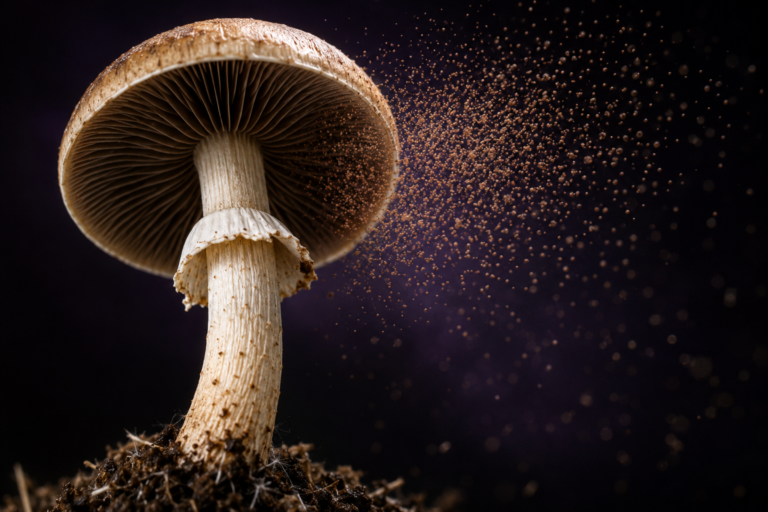
A partial veil stretches from the edge of the cap to the stem, covering the developing gills while the mushroom is immature.
As the cap expands, the partial veil tears away, often leaving behind a ring around the stem known as an annulus.
Not every species forms a visible ring, but when present it becomes an important identification feature.
What Is a Universal Veil?
A universal veil surrounds the entire young mushroom before it emerges from the ground.
When the mushroom grows, this veil splits apart.
It may leave behind:
- A cup-like structure at the base called a volva
- Small patches or warts on the cap
- Fragments attached to the stem
These remaining structures are often valuable clues during identification.
Why Mushroom Veils Matter
The mushroom veil protects delicate reproductive structures while the mushroom develops.
Once the mushroom reaches maturity, the veil breaks apart, allowing spores to be released from the gills or other spore-bearing surfaces.
Although temporary, the veil often leaves permanent evidence that can be examined long after it has torn.
Identifying Veil Remnants
When examining a mushroom veil, mycologists look for:
- Stem rings (annulus)
- Volvas at the base
- Cap patches
- Hanging fragments around the cap edge
- Surface texture changes
These characteristics are always considered alongside cap shape, gills, spores and stem features.
Common Beginner Mistakes
People learning about the mushroom veil often:
- Forget to examine the base of the stem
- Mistake dirt for a volva
- Assume every ring indicates the same species
- Ignore small veil fragments on the cap
- Attempt identification using only veil characteristics
Successful identification requires examining multiple features together.
Frequently Asked Questions
Does every mushroom have a mushroom veil?
No. Some mushrooms develop without any visible veil structures.
What is the difference between a partial and universal veil?
A partial veil protects the gills, while a universal veil surrounds the entire young mushroom.
Does a mushroom veil always leave a ring?
No. Some partial veils disappear almost completely or leave only faint traces.
Final Thoughts
The mushroom veil plays an important role during a mushroom’s early development by protecting delicate structures until they are ready to release spores. Although the veil is temporary, the ring, volva and other remnants it leaves behind are among the most useful features for mushroom identification.
Learning to recognise both partial and universal veils is an important step for anyone studying mushroom anatomy or beginning their journey into mycology.