The Mushroom Life Cycle Explained: From Spore to Mushroom
The mushroom life cycle is one of nature’s most fascinating biological processes. Every mushroom begins as a microscopic spore before developing into an underground network of fungal cells and eventually producing the familiar fruiting body we recognise as a mushroom.
Understanding the mushroom life cycle helps explain how fungi reproduce, spread through the environment and play an essential role in ecosystems around the world.
Stage 1: Mushroom Spores
The mushroom life cycle begins with spores.
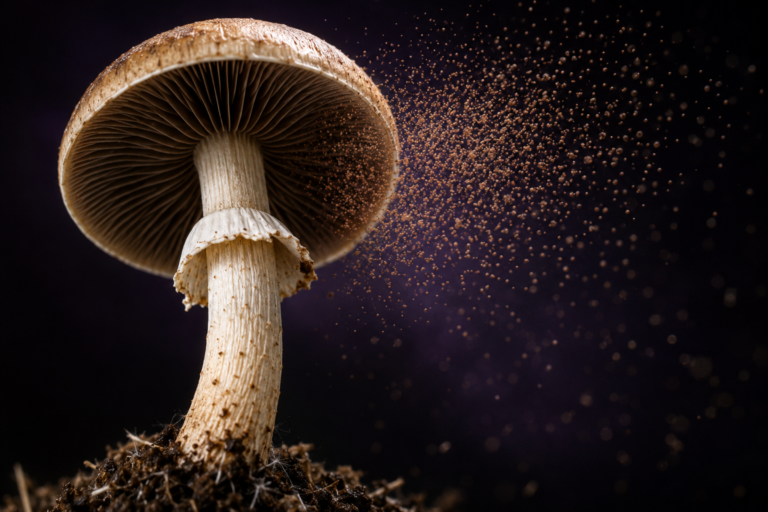
These microscopic reproductive cells are released by mature mushrooms and carried by wind, water or animals into new environments. Because the chances of a single spore surviving are very low, mushrooms release millions of spores during their lifetime.
Only a tiny percentage eventually land in suitable conditions for further development.
Stage 2: Spore Germination
When environmental conditions are favourable, a spore begins to germinate.
During this stage of the mushroom life cycle, the spore produces tiny thread-like structures known as hyphae.
These microscopic filaments grow through organic material while absorbing nutrients from their surroundings.
Stage 3: Mycelium Development
As hyphae continue to grow, they form an interconnected network called mycelium.
Mycelium is the main body of the fungus and usually remains hidden beneath soil, leaf litter or decaying wood.
Although mushrooms are the most visible part of a fungus, the mycelium performs most of the nutrient absorption throughout the mushroom life cycle.
Stage 4: Mushroom Formation
When environmental conditions are suitable, the mycelium begins producing a fruiting body.
Small structures gradually develop into mature mushrooms, complete with a stem, cap and spore-producing surface.
This is the stage of the mushroom life cycle most people recognise in nature.
Stage 5: Spore Production
Once mature, the mushroom begins producing new spores beneath the cap.
Depending on the species, spores develop on:
- Gills
- Pores
- Teeth
- Ridges
Millions of spores are released into the surrounding air, allowing the mushroom life cycle to begin again.
Why the Mushroom Life Cycle Matters
The mushroom life cycle plays an essential role in healthy ecosystems.
Fungi help:
- Break down dead organic matter
- Recycle nutrients
- Form beneficial relationships with plants
- Support forest health
- Maintain biodiversity
Without fungi, many natural ecosystems would function very differently.
Common Beginner Misconceptions
When learning about the mushroom life cycle, beginners often believe:
- Mushrooms are the entire fungus.
- Every spore becomes a mushroom.
- Mushrooms only grow in forests.
- Fungi reproduce like plants.
- All mushrooms have identical life cycles.
While the overall process is similar across many species, individual fungi can have unique adaptations.
Frequently Asked Questions
What is the first stage of the mushroom life cycle?
The mushroom life cycle begins with microscopic spores being released from mature mushrooms.
What is mycelium?
Mycelium is the underground network of fungal threads that absorbs nutrients and eventually produces mushrooms.
Why do mushrooms release millions of spores?
Only a very small number of spores survive and encounter suitable conditions, so producing millions increases the chance of successful reproduction.
Final Thoughts
The mushroom life cycle is a remarkable example of nature’s efficiency. From microscopic spores to extensive underground mycelium and finally mature mushrooms, every stage contributes to the survival and spread of fungi.
Learning about the mushroom life cycle provides a strong foundation for understanding mushroom anatomy, fungal biology and the important role fungi play in ecosystems around the world.
Continue Your Mycology Journey
Interested in learning more about mushroom anatomy, spores and microscopy? Visit the SporeZilla Marketplace to explore educational resources and browse listings from independent vendors.
External Link
Learn more about fungal taxonomy and accepted species names by visiting MycoBank.